

What's Driving Population Growth in Indiana Counties and Regions?
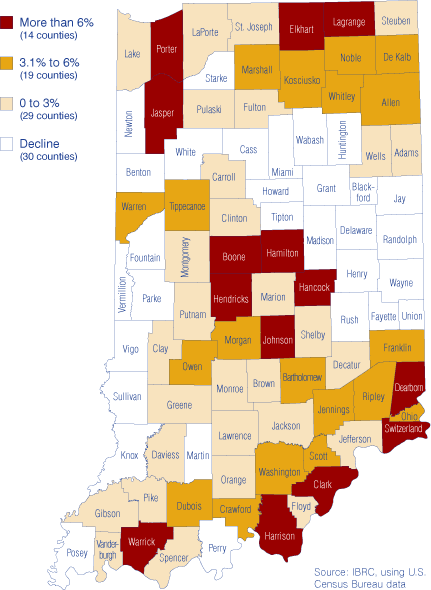
Indiana has just over 233,000 more residents than it did at the time of Census 2000, according to county-level population estimates for 2006. Sixty-two counties grew, while 30 declined (see Figure 1). Not surprisingly, growth was concentrated in suburban fringe counties.
Figure 1: Percent Change in Population, April 2000 to July 2006
Of course, there are essentially two ways for a population to grow:
- Natural Increase: the number of babies born surpass the number of deaths
- In-Migration: more people move into an area than move out of it
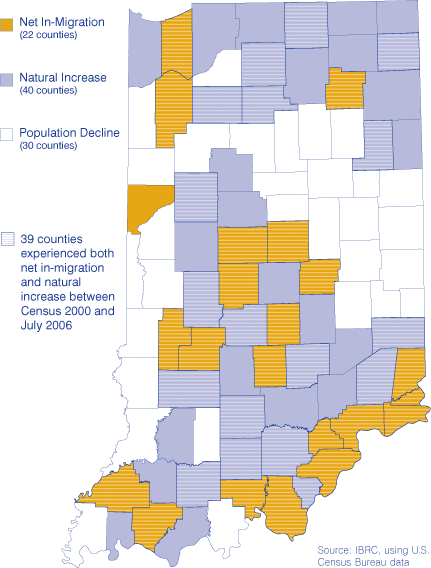
So that leads to the question, “Why are counties growing?” Natural increase drove the population gain in 40 counties, while in-migration contributed the most to population growth for 22 counties (see Figure 2). Of all 62 counties with population gains, 39 (or 63 percent) experienced both in-migration and natural increase.
Figure 2: What's Driving County Population Gain?, April 2000 to July 2006
It is also worth remembering that the migration situation changes a bit when we break migration down into internal (or domestic) migration and international migration (see Figure 3). At the county-level, 41 counties experienced total in-migration (when domestic and international migration are added together).
Figure 3: Total, Domestic and International Migration, April 2000 to July 2006
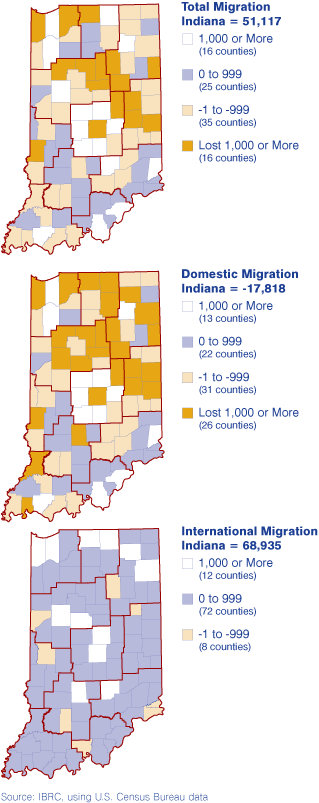
Taken separately, 83 of Indiana's 92 counties had positive international migration, while only 35 counties had positive domestic migration between 2000 and 2006. Thus, many counties are gaining residents from around the world even if they are not gaining residents from across the United States.
Regional Growth
Table 1 looks at Indiana's population change by economic growth region (EGR). Only two regions (EGR 6 in east-central Indiana and EGR 7 in west-central Indiana) lost population between 2000 and 2006. The others added between 4,500 (EGR 8) to more than 137,000 residents (EGR 5).
Table 1: Population Change by Economic Growth Region, April 2000 to July 2006
| Economic Growth Region | Total Population Change* |
Natural Increase |
Net Migration |
||||
Total |
Births |
Deaths |
Total |
Net International Migration |
Net Internal Migration |
||
| 5 | 137,072 | 77,238 | 162,335 | 85,097 | 60,913 | 20,931 | 39,982 |
| 1 | 24,917 | 20,967 | 69,616 | 48,649 | 6,542 | 6,130 | 412 |
| 2 | 21,195 | 24,783 | 56,529 | 31,746 | -1,880 | 12,146 | -14,026 |
| 3 | 19,092 | 28,661 | 67,477 | 38,816 | -7,267 | 7,248 | -14,515 |
| 10 | 13,488 | 5,568 | 21,401 | 15,833 | 8,755 | 850 | 7,905 |
| 9 | 13,192 | 9,354 | 26,440 | 17,086 | 4,767 | 2,595 | 2,172 |
| 11 | 7,431 | 6,603 | 33,055 | 26,452 | 2,142 | 1,941 | 201 |
| 4 | 4,819 | 13,116 | 39,988 | 26,872 | -6,868 | 10,122 | -16,990 |
| 8 | 4,537 | 5,662 | 21,695 | 16,033 | -247 | 4,329 | -4,576 |
| 7 | -1,997 | 1,781 | 16,714 | 14,933 | -3,085 | 1,081 | -4,166 |
| 6 | -10,743 | 2,995 | 26,256 | 23,261 | -12,655 | 1,562 | -14,217 |
Source: IBRC, using U.S. Census Bureau data
Five of the nine growing EGRs experienced both in-migration and natural increase. However, natural increase drove the population growth in all the EGRs, with the exception of EGR 10 (where migration outpaced natural increase by roughly 3,200). In fact, in that region, which includes the Louisville suburbs, migration accounted for 65 percent of the total population change—the largest percentage for any EGR. Even more astonishing, 90 percent of the total migration into EGR 10 was domestic migration and not international migration (for comparison, that same figure ranged from 6 percent in EGR 1 to 66 percent in EGR 5).
All of the EGRs had positive international migration, ranging from 850 people in EGR 10 to almost 21,000 in EGR 5. However, only five EGRs had positive domestic migration, including EGRs 1, 5, 9, 10 and 11 (that is, the regions around Indianapolis, Gary, Columbus/Cincinnati, Louisville and Evansville). Domestic migration growth ranged from 201 (3 percent of total change) in the Evansville region to nearly 40,000 (29 percent of total change) in the region surrounding Indianapolis.
Rachel Justis, Managing Editor
Indiana Business Research Center, Kelley School of Business, Indiana University