

Mid-Year Outlook for the Economy
Sluggish growth for the remainder of 2003. Acceleration during 2004. A strong 2005. This is what the June forecast by the Kelley School of Business' Center for Econometric Model Research (CEMR) at Indiana University calls for in the coming years.
From the June Forecast
The revised first quarter Gross Domestic Product showed slightly stronger growth than the advance numbers released in April. The overall growth rate for the quarter was raised from 1.6 percent to 1.9 percent, the increase coming from higher consumer spending on nondurable goods and a slightly lower trade deficit. These positive factors were partly offset by lower estimates for most other spending components. Perhaps most notable, business investment in equipment showed a decrease of 6.3 percent.
According to the Center, the few pieces of monthly data received so far for May contained no negative surprises, but nothing to shout about either. Consumer confidence rose slightly after its large jump in April, but is still below encouraging levels. Consumer expectations (a variable used in the Center's model) registered a larger gain, while auto sales fell off in May to 16.1 million units. This annual rate is about a million below the average of the past three years. The labor market is not quite holding its own. The unemployment rate edged up to 6.4 in June, while payroll employment continued to fall.
Policy Assumptions
- The Federal Reserve lowered short-term interest rates by 25 basis points at its June 25th meeting. The forecast included a 25 basis point reduction, but a 50 basis point cut was not out of the question. The Fed is expected to maintain this rate through 2003.
- Defense spending will be elevated over the next two years.
- The just passed tax cut will produce a significant drop in personal taxes in the third quarter.
Future Path of Economy
- Adequate but sluggish growth for the rest of this year (averaging 2.5 percent).
- Acceleration during 2004 (3.5 percent fourth quarter to fourth quarter).
- A strong 2005 (3.7 percent growth).
- Much of the disposable income from the tax cut is saved (rather than spent), at least immediately. This is consistent with economic theory if households believe that the lower taxes are only a temporary phenomenon.
- The tax cut will significantly increase the federal deficit, which rises toward $400 billion.
Indiana
Because the Indiana economy is heavily influenced by the auto and construction industries, it will continue to more keenly feel the effects of the sluggish national economy. Economist Jim Smith from the Kelley School of Business questions how long super-low interest rates will keep the car and housing businesses strong. How long, Smith asks, can U.S. carmakers continue to give zero percent financing when they are losing market share, and how many more people can afford new homes if they are facing the unemployment line?
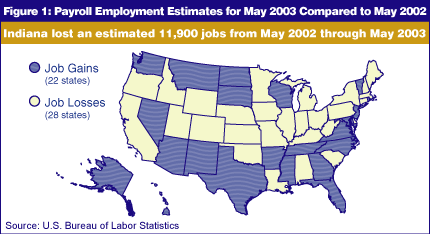
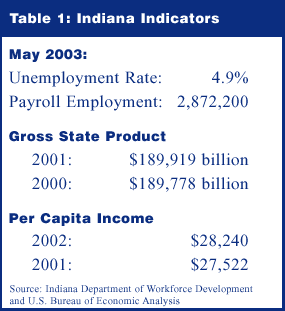
Figure 1 and Table 1 show recent indicators of Indiana’s economic performance.
A Note on the Unemployment and Payroll Data
from the Bureau of Labor Statistics:
The payroll data have been substantially revised and reflect an annual benchmarking. The old data showed job gains last summer, followed by large declines in employment more recently. The revised data show flat employment last summer and fall, meaning that the recent job loss now appears less severe. The disaggregate data were also converted to NAICS codes.
Carol O. Rogers
Associate Director, Indiana Business Research Center,
Kelley School of Business, Indiana University